313,000 “Janfada” for Iran
Tehran stages a defiant display of sacrifice and unity
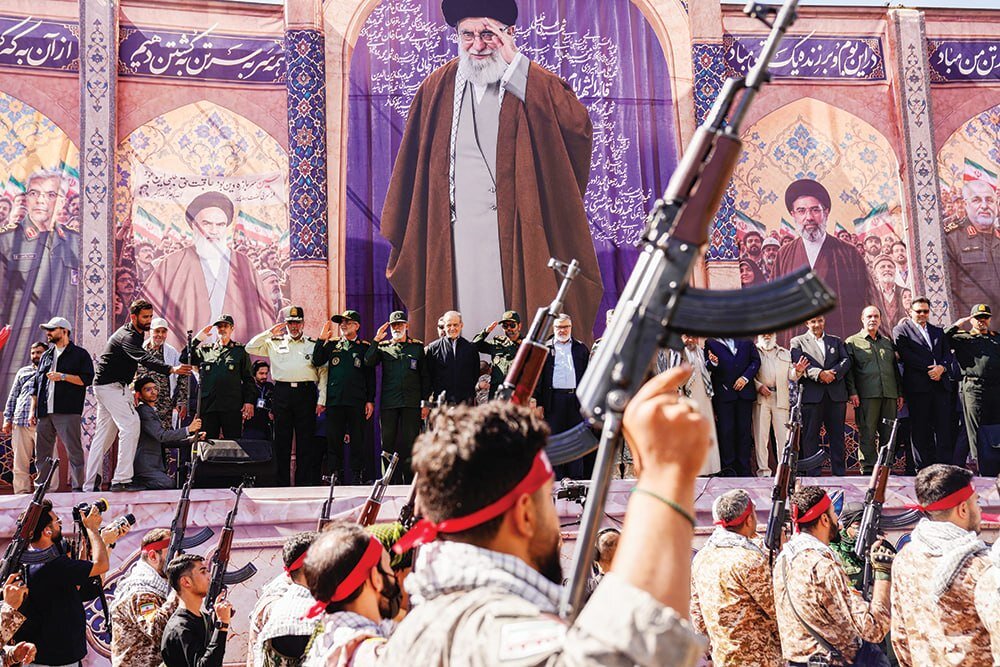
TEHRAN — From Imam Hussein Square to Enghelab Square, Tehran’s streets on Friday became the setting for one of the largest public mobilizations seen in Iran since the war began in February. Hundreds of thousands of people took part in the “Janfada-ye Iran” — Devoted to Iran — campaign, with women, young people, veterans and other sections of society joining a 313,000-strong parade, according to Iranian organizers.
The scale of the gathering was matched by the symbolism surrounding it. Participants marched under Iranian flags, military banners and images associated with the country’s wartime resistance. Iranian drones and other military equipment were displayed along the route, while veterans of the Sacred Defense and volunteers in military-style formations took part in the parade. Some participants wore white burial shrouds — a stark traditional symbol of readiness to give one's life for the country.
The photographs from Tehran captured the atmosphere from different angles. In one image, a woman in camouflage and a green headband is seen positioned beside a vehicle, looking through the sight of a rifle. In another, a woman with her face partially covered by a patterned scarf holds an assault rifle while other women stand behind her amid Iranian and other flags. The images offer a striking visual of the campaign's central message: that the call to defend the country is being presented not solely through conventional military formations, but also through the participation of civilians, including women.
313,000: A number loaded with history
The choice of 313,000 is not simply a numerical designation.
In Islamic tradition, 313 is associated with the companions of the Prophet Muhammad at the Battle of Badr in 624 CE and, in Shiite tradition, with the number of devoted companions associated with the Imam of the Age. For the organizers of Friday's event, the number therefore carries a religious and historical meaning of steadfastness, loyalty and readiness to stand with a cause at a moment of crisis.
That symbolism was visible throughout the rally. The parade was not presented merely as a military exercise but as a public declaration of readiness, with participants repeatedly invoking the ideas of homeland, independence, national unity and sacrifice.
According to Gen. Hassan Hassanzadeh, commander of the Greater Tehran Islamic Revolution Guard Corps (IRGC), around 500,000 people had registered in Tehran for the initiative. Iranian organizers have separately said that more than 31 million people have registered nationwide, while other Iranian reports put the cumulative figure above 32 million.
A rally born in wartime
What gives the Janfada campaign its particular character is the circumstances in which it has developed.
The campaign began on March 29, following the US-Israeli attack on Iran on February 28, and has since evolved from a registration drive into a nationwide mobilization involving public gatherings, volunteer organization and preparations for training. Iranian officials say the volunteers are being organized into formations capable of contributing to national defense and other emergency tasks.
Friday's rally therefore came against the backdrop not of a distant or concluded war, but of an ongoing conflict, economic pressure and severe restrictions on Iran's trade and access to international markets. Recent reporting has also documented the effects of the US blockade and sanctions on Iran's economy and commercial routes.
This is an important distinction when placing the gathering in historical perspective. Across history, societies have mobilized around the idea of sacrifice when confronted by an existential military threat — from the Greek defenders at Thermopylae and the Soviet defense of Stalingrad to the French Resistance during World War II and Iran's own mass mobilization during the 1980–88 Iran-Iraq War.
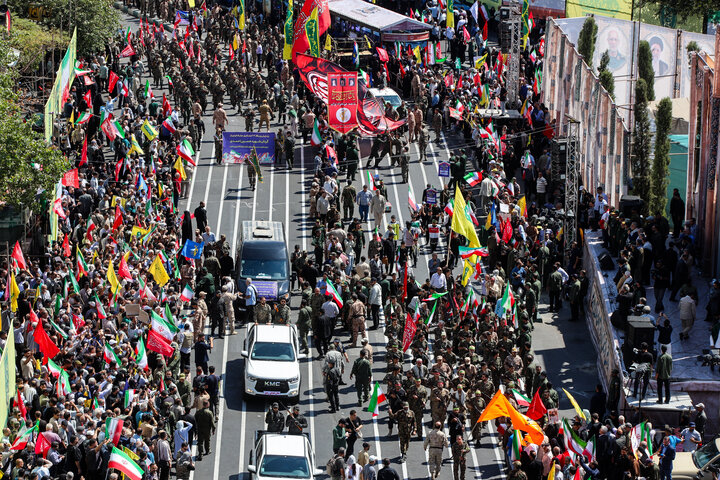
But Janfada is being organized under a different set of circumstances. It combines a modern state-wide registration campaign, social-media mobilization, religious symbolism, and military-style public exercises while the conflict itself is still unfolding and while the country is simultaneously confronting economic pressure.
It is this combination that has given the campaign much of its political and social significance inside Iran.
Women, youth and veterans in the same formation
The Friday parade also sought to project an image of participation across generations.
Women appeared prominently in the event, including women in military-style uniforms and others carrying rifles. Young people took part alongside veterans of the Sacred Defense. Newly engaged couples were also reported among the participants, while a Jewish rabbi and a Yemeni delegation wearing traditional clothing were present, according to Iranian media reports.
President Masoud Pezeshkian, who attended the gathering, emphasized this diversity in his remarks. He described the turnout as a manifestation of the bond between the Iranian people and their homeland and stressed that “Iran belongs to all Iranians.” He called for unity and broad public participation in preserving 'the country's dignity, independence and territorial integrity.'
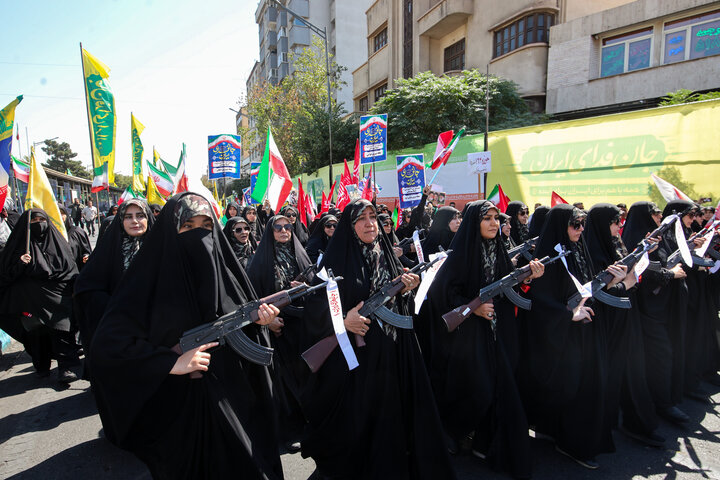
The message was significant: the campaign was being presented not simply as a gathering of members of Iran's military or paramilitary organizations, but as a national mobilization cutting across different sections of society.
From the 'Sacred Defense' to a new generation
Iran's modern experience of mass mobilization is inseparable from the Iran-Iraq War, known in Iran as the Sacred Defense.
During that eight-year conflict, Iran mobilized large numbers of volunteers through the Basij and other wartime structures. For an entire generation, the experience created a cultural vocabulary in which sacrifice, martyrdom, national defense and civilian participation became closely intertwined.
The Janfada campaign draws on that historical memory while speaking to a new generation.
The images from Tehran are particularly revealing in this respect. The rifles, uniforms and military vehicles evoke the visual language of wartime mobilization, while the presence of young people and women gives the event a distinctly contemporary character. The burial shrouds worn by some participants add another layer: rather than presenting sacrifice as an abstract concept, the participants were visually associating themselves with the possibility of death in defense of their country.
A message beyond Tehran
The significance of Friday's gathering also extends beyond the capital.
Iranian officials have said that Janfada gatherings are taking place in cities across the country and that the campaign is moving toward the organization and training of volunteer units. Basij chief Hossein Taeb said the volunteers were being prepared for “full-fledged defense,” while Iranian reports said training programs were being developed across ground, air and naval domains.
The campaign has consequently become both a domestic mobilization and an international signal.
For Tehran, the message is that the country's capacity to organize people around national defense has not disappeared under the weight of war, sanctions and economic pressure. The government is presenting the turnout as evidence of national resilience and social cohesion.
When a nation says it is ready
The most powerful element of Friday's scenes may not have been the military hardware displayed along Tehran's streets. It was the human presence surrounding it.
A woman holding a rifle. A veteran marches beside younger volunteers. Families moving through the crowd. Participants wearing burial shrouds. Flags rising above a sea of people stretching through one of Tehran's historic arteries.
For Iran, the language of Janfada reaches deep into a historical memory in which the survival of the homeland has repeatedly been associated with endurance and sacrifice.
Yet this time the setting is different. The pledge is being made while war is still being fought, while economic pressure is intensifying.
That is what makes the September 18 rally more than a single day's parade. It is the latest chapter in a campaign that seeks to transform the idea of sacrifice into an organized form of public participation — and to demonstrate, in the heart of Tehran, that the war has not removed the country's ability to mobilize large numbers of people around the defense of Iran.
Leave a Comment